New platform: Meitner   |   We have moved from SchoolSoft to Meitner – our new platform for information, communication and learning.

Primary Year Programme: PYP

Our Bilingual IB Programme is an authorized International Baccalaureate World School since 2009. The Primary Years Programme (PYP) at our school caters for pupils aged between 5 and 11. The Bilingual IB Programme is based on the IB framework in combination with the Swedish National Curriculum (Lgr22). These classes are taught both in English and Swedish, providing an invaluable opportunity for pupils to learn in a bilingual context.
Primary Years Programme

An International Baccalaureate® World School that meets all the requirements of the Swedish national curriculum.

Our Bilingual IB Programme is an authorized International Baccalaureate World School since 2009. The Primary Years Programme (PYP) at our school caters for pupils aged between 5 and 11. The Bilingual IB Programme is based on the IB framework in combination with the Swedish National Curriculum (Lgr22). These classes are taught both  in English and Swedish, providing an invaluable opportunity for pupils to learn in a  bilingual context.

Our Early Year class for students aged 5-6 is a mixed class, with about 18 students and two  teachers. One of the teachers uses English as language of instruction with the pupils and the other teacher uses Swedish.  That way our Early Years students get a good basis for both languages to succeed in our programmes.

The Bilingual IB Programme is located at Luntmakargatan 101.

Teaching and learning in the PYP

Being an IB world school means that it is our aim to educate for life. Our ambition is to create internationally minded and knowledgeable citizens. We know that our students get a good start for higher education, whether it be a Swedish gymnasium, the IB Diploma program or a college/high school somewhere else in the world. Many come back to visit providing us with positive feedback regarding the success of our goals.

The PYP programme focuses on the overall development of the child as an inquirer in the classroom, and in the world at large. The programme includes six specified subjects – language, maths, science, social studies, arts, personal, social and physical education – and emphasises interdisciplinary skills and independent inquiry.

PYP focuses on a range of areas related to pupils’ overall development, including: academic, social and emotional well-being; independence and the ability to take responsibility for their own learning; understanding the world and to function comfortably as part of it; establishing personal values centred around a global outlook and consideration for others.

Student agency in the heart of the PYP

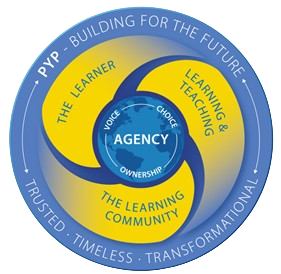
The PYP comprises of three pillars: The Learner, Learning and Teaching and the Learning Community.
Student agency, which ensures that the studens have a voice, choice and take ownership of their learning, is the centre of the new enhanced PYP.

PYP_Logo1

The essential elements of the PYP:

The PYP has compiled the essential elements which are used in the classroom to aim towards a balance in the program of study. These are:

1.Knowledge
2.Concepts
3.Skills
4.Action
Each essential element contributes to the social and cognitive development of a child. These essential elements create the foundation of the PYP and set it apart from other thematic approaches to learning.

1.Knowledge - What do we want the students to know?

As PYP is a transdisciplinary program most subjects are taught in our units of inquiry. A school year at Vasa International always consists of six units of inquiry. These units are based upon a central idea, which the teacher and the students explore for a number of weeks, usually 4-6. Both students and parents need to be actively working with the central idea during the current unit.

Doing so helps the students deepen their understanding and inquire deeper into the unit at hand.

Sample Unit of Inquiry (UOI)

Transdisciplinary theme:​ How we express ourselves
Title of unit of inquiry:​ The impact of advertising
Central idea:​ Advertising influences how we think and the choices we make
Lines of inquiry:
– The purpose of advertising
– The types, styles and locations of advertisements
– The devices used to make advertising effective and to influence our choices

The PYP transdisciplinary themes:
● Who we are
● Where we are in place and time
● How we express ourselves
● How we organize ourselves
● How the world works

Sharing the planetAll science and social studies education will be taught inside the framework of the units and often many other subjects will be part of them as well. If some of the subject specific goals and skills do not fit under the unit work, they will be taught as stand alone topics.

PYP-1

2. Concepts​ - What do we want the students to understand?

He  teacher  and  students  will  look  at  the  inquiry  at  hand  through  different  conceptual lenses, to give the students chances to make connections over the subject boundaries.

The PYP Key concepts:

  • Form
  • Function
  • Responsibility
  • Causation
  • Connection
  • Change
  • Perspective

3. Approaches to Learning (Skills) ​- What do we want the students to be able to do?

It  is  important  for  the  student  to  not  only  learn  certain  skills,  but  also  to  understand  them  and  to  be  able  to  connect  skills  in  different  subject  areas  to  each other. When  studying a certain unit of inquiry, the teacher identifies which skills will  be necessary for the students to develop and understand. The students will also have time  to  reflect  over  the  skills  and to what extent they think the skills were applied in  that certain unit of inquiry.

The PYP Transdisciplinary Skills:

  • Thinking Skills
  • Social Skills
  • Communication Skills
  • Self-management Skills
  • Research Skills
PYP-2
PYP-3

4. Action ​- How do we want the students to act?

The PYP believes that successful inquiry will lead to responsible student action. As an IB school, it is Vasa International’s obligation to make sure that there is opportunity for  action  within  the  unit  of  inquiry.  The  teacher will guide the students in choosing  action, and acting and reflecting over their action in order to make a difference in the world.  

The PYP Exhibition

The ‘Exhibition’ is important part of the PYP. In the final year of the programme, students undertake a collaborative, interdisciplinary inquiry process that requires them to identify, investigate and propose solutions to real-life issues or problems.They then present their findings to the community. As the culminating experience of the PYP, the Exhibition offers students an exciting opportunity to demonstrate independence and responsibility for their own learning and it is also a way to celebrate their transition from the PYP to the MYP.

Child with Computer